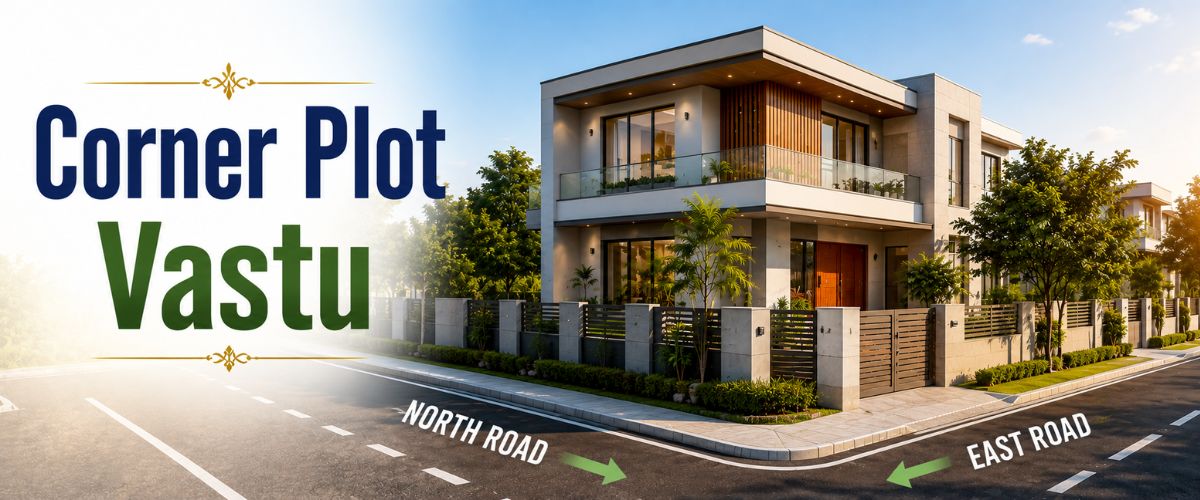
A corner plot is a property that sits at the intersection of two roads, meaning it has open road access from two sides instead of one. In Vastu Shastra, this dual road exposure makes a corner plot fundamentally different from a regular plot because it receives energy from two directions simultaneously. The specific combination of those two directions determines whether the plot is auspicious or inauspicious.
Corner plot Vastu is the set of ancient guidelines that governs how to select, design, and construct a home on such a property so that the dual energy flow works in favour of the residents. Unlike a standard plot where energy enters from one direction, a corner plot amplifies the energy of whichever two directions it faces. This amplification can bring extraordinary prosperity when the directions are favourable, or significant problems when they are not.
In Indian real estate, especially in cities like Jaipur, Delhi NCR, Noida, and Bangalore, corner plots are marketed as premium properties because of their extra light, ventilation, and open space. But from a Vastu perspective, a premium price does not mean a premium life outcome. The direction of the two roads, the shape of the plot, the slope of the land, and the placement of the entrance are what truly decide whether that corner plot will bring peace and wealth to the family.
If you are looking for a Vastu-compliant residential plot near a sacred location, Khatu Green Heaven offers RERA-approved plots in Reengus, close to the revered Khatu Shyam Ji Temple in Rajasthan.
A corner plot is neither universally good nor universally bad as per Vastu. Its outcome depends entirely on which two directions the roads fall on. A plot with roads on the North and East sides is considered highly auspicious. A plot with roads on the South and West sides is considered highly inauspicious and generally should be avoided.
The reason corner plots are often preferred is that they allow natural light and fresh air to enter from two sides, which Vastu science links directly to positive energy flow and good health. Open space on two sides also ensures that the North East zone of the plot remains free and open, which is the most sacred and energy-rich zone in Vastu Shastra.
However, the same dual-road exposure becomes a problem when it faces South and West, or South and East. These combinations carry excess fire and earth energies that, if not corrected through Vastu remedies, can lead to financial instability, health issues, and family disputes. So the correct answer to "is corner plot good or bad" is: it depends on which corner it is.
The North East corner plot, where roads exist on both the North and East sides, is considered the best corner plot as per Vastu. This plot receives morning sunlight from the East and positive cosmic energy from the North, making it the most auspicious combination for residential construction.
After the North East corner plot, the North West corner plot ranks second in terms of Vastu favourability. It has roads on the North and West sides and belongs to the Vavaya category in Vastu. With proper construction guidelines — particularly by keeping the South West corner elevated — this plot can bring good results for the residents.
The South East corner plot (roads on South and East) and the South West corner plot (roads on South and West) are considered the least favourable. These are called Agneya and Nairutya plots respectively, and Vastu shastra advises serious caution or avoidance when purchasing these plots for residential use. If you are buying a corner plot as a real estate investment, always check the road directions before making any decision.
The North East corner plot is known as the Ishanya plot in Vastu Shastra and is regarded as the most auspicious of all corner plot types. The North East direction is ruled by divine energies associated with wisdom, spiritual growth, health, and prosperity. A home built on this plot, when constructed correctly, brings long-term financial stability, good health, and peace of mind to the residents.
The ideal construction on a North East corner plot keeps the North and East sides open with lower compound walls, and builds heavier structures on the South and West sides. The main entrance should ideally face North or East, and the Northeast zone inside the plot should be kept clean, open, and free of heavy construction or toilets. Underground water storage like a borewell is best placed in this North East corner.
An extended North East corner (where the plot slightly projects outward in the North East direction) is considered especially auspicious in Vastu. It is believed to bring increase in wealth, growth in family, and success in business. However, a cut or missing North East corner is a serious Vastu dosh. If you have a plot where the North East corner is chopped off or irregular, remedies such as placing a Vastu Kalash with water and silver coins, growing a Tulsi plant in the zone, and using crystal water cubes near the cut area are recommended.
A North East facing corner plot means the main entrance of the house is oriented towards the North East direction. This is considered extremely favourable in Vastu because the Northeast direction channels divine, positive, and prosperity-bringing energy directly into the home through its entrance. Residents of North East facing homes generally report better career growth, improved health, and a sense of spiritual well-being.
For a North East facing corner plot, the main door should open towards the North or East. The compound wall on the North and East sides should be lower than the compound wall on the South and West. Kitchen should be placed in the South East corner inside the home, and the master bedroom should be in the South West corner of the plot to ensure stability and strength.
The North East facing corner plot is particularly good for families with school-going children because the Vastu energy associated with this zone enhances learning, concentration, and knowledge. It is also beneficial for people in professions like education, healthcare, astrology, and spiritual services. When buying a corner plot in cities like Jaipur or NCR, a North East facing corner plot justifies its premium price from a Vastu standpoint.
A North East extended corner plot refers to a plot where the North East corner projects outward, meaning the land area extends slightly beyond the rectangular boundary in that direction. This is one of the most auspicious plot configurations in all of Vastu Shastra. The extension in the North East is believed to multiply positive energy, wealth, and progeny for the family.
Vastu experts consider North East extension to be directly beneficial for financial growth, increase in property value, and spiritual development of the family. Unlike other directional extensions which can be problematic, the North East extension is specifically encouraged. Residents living in homes on North East extended plots often experience rapid career growth and business expansion.
The only precaution with a North East extended plot is to avoid building any heavy structure, toilet, septic tank, or kitchen in that extended North East portion. The extension should be kept open, clean, and ideally used as a garden, meditation space, or water feature zone. Placing a Tulsi plant or a small water fountain in the extended North East zone magnifies the positive benefits.
The North West corner plot, known as Vavaya in Vastu Shastra, has roads on the North and West sides. It is considered a moderately auspicious plot that can give good results when Vastu guidelines are carefully followed during construction. The North West direction is ruled by the Vayu tatva, which is the air element, and it governs social relationships, movement, business connections, and marriage.
For a North West corner plot, the most critical Vastu rule is to ensure that the South West corner of the plot is higher in level than the North East corner. This slope ensures the natural energy flow goes from South West to North East, which is the correct direction as per Vastu science. The compound wall on the South and West sides should be taller and heavier than on the North and East sides.
The main entrance of a house on a North West corner plot should face North or West. Rooms like the master bedroom can be placed in the South West zone, and the kitchen works best in the South East zone. The North West zone inside the home is ideal for guest rooms, children's rooms, or study rooms. A North West corner plot is considered good for people in business, trade, or fields that involve frequent travel and social networking.
A North West facing corner plot means the main entrance or the front face of the property opens towards the North West direction. This is considered a moderately favourable orientation in Vastu but requires careful internal planning to ensure the energy is properly channelled. The North West direction is associated with Vayu (air) energy, which brings movement, change, and social expansion.
For a North West facing corner plot, it is important that the main door is not placed exactly at the extreme North West corner of the boundary. Instead, the door should be slightly shifted towards the North side of the West wall, or towards the West side of the North wall, to avoid the exact corner placement which can cause instability. Heavier rooms like the master bedroom must be placed in the South West interior zone of the home.
North West facing corner plots are particularly suitable for individuals in business, sales, marketing, and social work, as the Vayu element of this direction supports travel, communication, and networking. When internal Vastu planning is done correctly — with the kitchen in South East, pooja room in North East, and master bedroom in South West — a North West facing corner plot can deliver prosperity and family harmony.
A North West extended corner plot is a plot where the land projects outward in the North West direction beyond the standard rectangular boundary. This type of extension, unlike a North East extension, requires caution. In Vastu Shastra, a North West extension is generally considered to increase instability, financial uncertainty, and restlessness in the lives of residents.
The reason a North West extension is problematic is that it amplifies the Vayu element excessively. While some amount of Vayu energy is good for movement and business, too much of it causes mental unrest, sleeplessness, unnecessary travel, and difficulty in making stable decisions. Family members may experience frequent arguments or a sense of inability to settle down.
If you already have a North West extended corner plot, Vastu remedies include using heavy earth element objects like rocks, boulders, or yellow-coloured objects in the extended zone to balance the excess air energy. Placing lead blocks or earth crystals in the North West extended area helps ground the energy. Consulting a Vastu expert before construction on such a plot is strongly advised so that the building layout can counterbalance the extension's energy.
The South East corner plot is called the Agneya plot in Vastu Shastra because the South East direction is governed by Agni, the fire element. This plot has roads on the South and East sides. While the fire element brings energy, ambition, and career drive, an Agneya corner plot is generally considered inauspicious for residential construction because of the imbalanced energy it creates.
The excess of fire energy in a South East corner plot leads to financial stress, mental pressure, frequent conflicts, and health problems particularly related to digestive issues and blood pressure. Vastu experts note that this plot type is especially unfavourable for women living in the household, as the excess Agni creates emotional imbalance and stress.
However, the South East corner plot is considered favourable for commercial or industrial use. Factories, restaurants, and cooking-related businesses are believed to thrive on Agneya plots because fire energy supports these activities. If you are building a home on a South East corner plot, placing the kitchen in the South East interior zone helps channelize the fire energy constructively, and placing heavy structures on the South West zone helps balance the plot's energy.
A South East facing corner plot means the primary entrance of the property faces the South East direction. This is considered a less favourable facing for a home as per Vastu, because the fire element of the South East creates a conflict between the incoming energy through the main door and the natural energy balance needed inside a home.
For a South East facing corner plot, one of the most important remedies is to avoid placing the main entrance exactly at the South East corner. Instead, the entrance should be shifted towards the East wall (away from the South East corner) to reduce the direct impact of Agni energy entering the home. If the main entrance must face South East due to plot constraints, using green plants, water features on the North East side of the property, and heavy materials on the South West corner helps restore balance.
South East facing corner plots are more suitable for hotels, food businesses, and commercial establishments than for family residences. If you are evaluating a South East facing corner plot for residential purchase, always get a proper Vastu assessment done before finalising. The internal room layout — especially the position of kitchen, bedroom, and pooja room — plays a critical role in making a South East facing corner plot work for a family.
A South East extended corner plot means the property has extra land projecting outward in the South East direction. This is considered a significant Vastu dosh because it amplifies the fire element beyond the natural balance. Residents of a South East extended plot may experience financial unpredictability, excessive expenditure, disputes with authorities, and health issues related to fire-element imbalance.
Vastu science categorises South East extension as one of the extensions to avoid in residential plots. The reason is that South East is the zone of the fire element and extending it means the plot carries excessive fire energy, which manifests as anger, conflict, stress, and monetary losses in the lives of the residents. This effect is especially pronounced for women and elderly family members.
Remedies for a South East extended corner plot include adding the water element in the North East zone of the property through a small water feature or borewell, using blue or green colours in the interior of the South East extended area, and placing Vastu pyramids in the South East extension zone to neutralize negative energy. It is also advised to avoid placing the kitchen, main door, or master bedroom in the extended South East portion.
The South West corner plot is called the Nairutya plot in Vastu Shastra, with roads on both the South and West sides. This is widely considered the most problematic corner plot type for residential construction. The South West direction is ruled by the earth element and is also associated with Nairuti, a demon in Vastu terminology, and its ruling planet is Rahu.
Living on a South West corner plot without Vastu corrections can lead to financial instability, unexpected health problems particularly related to legs, kidneys, and bones, strain in marital relationships, and damaged social reputation. Vastu experts consistently advise either avoiding the purchase of a Nairutya corner plot or undertaking very detailed Vastu planning before construction begins.
However, some Vastu practitioners note that a South West corner plot can bring stability and strength if very specific rules are followed: the South West interior zone of the home should be the heaviest (master bedroom, almirah, locker), the North East should be kept completely open and light, the main entrance should never be on the South or West wall, and the boundary wall on South and West must be significantly taller and heavier than on North and East. With these measures in place, the plot's earthly energy can be harnessed for authority and stability.
A South West extended corner plot is a property where additional land extends outward in the South West direction, breaking the standard rectangular shape. This is considered one of the most serious Vastu doshas a plot can have. The South West extension amplifies the earth element and Rahu's influence, which manifests as chronic financial problems, major health issues, and severe relationship conflicts.
Vastu texts specifically list South West extension as the most harmful extension among all four directions. Unlike a North East extension which multiplies prosperity, a South West extension multiplies instability. Couples may face relationship difficulties or separation, family elders may have persistent health issues, and business owners may find their investments giving negative returns.
Remedies for a South West extended corner plot include partitioning the extended area from the main plot using a Vastu strip or a physical wall to symbolically separate the negative zone. Heavy earth element items like rocks, copper objects, and yellow or golden colours should be used in the SW extended area. Using Vastu pyramids and consulting a Vastu expert to assess the specific degree and extent of the extension is critical before deciding to build or buy such a plot.
A South facing corner plot means the primary road and main entrance face the South direction. South facing homes are often misunderstood as always being bad in Vastu, but this is incorrect. A South facing corner plot can give good results when the main entrance is placed in the correct padas (sections) of the South wall as defined by Vastu Shastra.
The most auspicious entrance positions on a South facing corner plot are the third and fourth padas from the left on the South wall, which correspond to the Vithi or the zone of the ruling deity of the South. Placing the entrance incorrectly in the extreme South West corner of the South wall is the actual cause of problems, not the South facing direction itself.
For a South facing corner plot, the North East zone of the interior should be completely open, with a garden, open courtyard, or water feature. Heavy construction must be placed on South and West interior areas. The compound wall on the South side should be taller than on the North side. South facing corner plots are believed to be beneficial for politicians, business leaders, and people in authority because the South direction in Vastu is also associated with fame and power.
An East facing corner plot means the primary road is on the East side and the main entrance of the home faces East. This is considered one of the most auspicious plot orientations in Vastu because the East direction is associated with the rising sun, new beginnings, vitality, and positive energy. East facing homes receive the first rays of morning sunlight directly through the entrance, which Vastu considers highly purifying.
For an East facing corner plot, the main door should be placed in the correct section of the East wall, ideally in the centre or slightly towards the North East. The interior planning should keep the North East zone the lightest and most open, place the kitchen in the South East interior, the master bedroom in the South West, and the children's rooms or study in the North West or West zones.
East facing corner plots are ideal for homes of teachers, students, doctors, and professionals where knowledge, health, and creativity are important. The morning sunlight energy entering through an East facing entrance is said to enhance the intelligence, health, and enthusiasm of children growing up in the home. When compared with other corner plot orientations, East facing corner plots are among the safest to buy without extensive Vastu corrections, provided the two roads are on East and North sides.
A West facing corner plot has its primary road and main entrance on the West side. In Vastu, West facing plots are considered moderately favourable. They are neither the most auspicious like North or East facing, nor problematic like South West or South East corner plots. The West direction is associated with the water element in some Vastu traditions and is governed by Saturn (Shani).
For a West facing corner plot, it is important that the internal room placement follows Vastu correctly to compensate for the less energetic nature of West facing. The main entrance should be on the West wall but placed in the correct pada — ideally the 3rd or 4th section of the West wall from the North side. North East of the interior should be kept open and light, and South West should carry the heaviest rooms.
West facing corner plots work well for people in business, service industries, and import-export trade. Saturn's governing influence on the West direction means that hard work done in a West facing home is consistently rewarded. The plot is also considered good for people who prefer a calm, private lifestyle. However, if the second road of the corner plot falls on the South side (making it a South West corner plot), then additional Vastu care is essential.
Corner plot Vastu dosh occurs when the natural energy flow of a corner plot is disrupted by incorrect construction, irregular shape, wrong entrance placement, or unfavourable road directions. The most common Vastu dosh in corner plots is a cut or missing corner — especially when the North East corner is chopped off due to road-cutting or irregular land boundaries. This missing North East corner is considered the most serious Vastu dosh in any property.
Another major Vastu dosh specific to corner plots is the placement of the main entrance in the wrong direction relative to the road. Because corner plots have two roads, buyers often make the mistake of opening the main entrance towards the less auspicious road (South or West) instead of the more auspicious one (North or East). This reverses the intended energy flow and is the root cause of many life problems that residents attribute to the corner plot being "bad."
Vastu dosh in corner plots also arises from having a triangular or irregular pentagonal shape, which happens when road widening or government setbacks cut the plot's corner. Remedy for corner plot Vastu dosh includes using Vastu pyramids at energy-deficient zones, placing Vastu yantra (specifically matched to the direction of the dosh), using appropriate elemental colours, growing Tulsi in the North East zone, keeping the South West heavy and closed, and getting a professional Vastu audit done before or during construction. Remember that remedies reduce the negative impact but do not fully eliminate a serious structural Vastu dosh — proper construction planning from the beginning is always the best solution.