How to Verify Developer Credibility Before Booking a Plot
Most buyers stop their due diligence the moment they see a RERA registration number on a project brochure. It feels reassuring — a government number, officially listed, surely that means the developer is trustworthy.
But a RERA number only confirms that a project is registered. It does not confirm that the developer will deliver on time, that the land title is clean, or that the amenities promised in the brochure will actually exist on the ground. Registration is the starting point of verification, not the end of it.
Here is what you should actually check before you pay a booking amount.
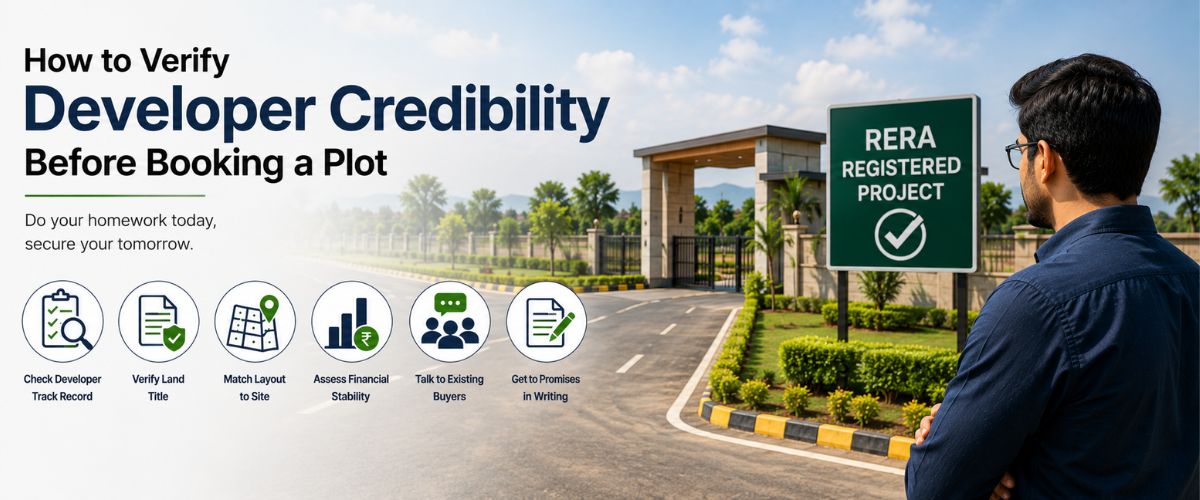
1. Look Up the Developer's Track Record, Not Just the Project
A RERA number tells you about one project. It tells you nothing about how many other projects this developer has delayed, litigated, or abandoned.
- Search the developer's name (not just the project name) on your state's RERA portal. Most portals let you filter by promoter name and show every project they have ever registered.
- Check the status of their older projects. Are they marked "completed," or are deadlines being extended repeatedly?
- Look for consumer complaints filed against the developer with RERA or in consumer courts. These are public records in most states.
A developer with five completed, on-time projects is a fundamentally different risk than a developer with one registered project and no history.
2. Verify Land Title Independently
RERA registration requires the developer to declare their title, but it does not independently certify that the title is dispute-free.
- Ask for the encumbrance certificate and check it yourself, or through a lawyer, rather than accepting the developer's summary.
- Confirm there is no pending litigation on the land — this is searchable on your state's revenue department or land records portal.
- If the land was agricultural before development, confirm NA (Non-Agricultural) conversion or equivalent approval has actually been granted, not just applied for. A conversion application in process is not the same as an approved conversion.
3. Match the Layout Plan to the Actual Site
Brochures show a sanctioned layout. What matters is whether the physical site matches it.
- Ask for the layout plan approved by the local development authority (JDA, DTCP, or equivalent) and compare plot numbers, road widths, and open spaces against what you see on your site visit.
- Check whether roads, drainage, and boundary demarcation already exist, or whether they are "planned" for a future phase.
- If a specific plot has been offered to you, confirm its exact location on the approved layout — not just verbally, but marked on the sanctioned plan.
4. Check Financial Stability, Not Just Marketing Spend
A developer running large ad campaigns is not the same as a developer with the financial capacity to complete infrastructure work.
- Ask how the project is funded — self-funded, bank-financed, or dependent on buyer installments to fund construction. Projects that rely entirely on incoming buyer payments to fund infrastructure carry more risk if sales slow down.
- Check if the project has any bank or NBFC approval for home loans. Lenders conduct their own due diligence before approving a project for financing, so bank approval is a useful secondary signal.
5. Talk to Existing Buyers, Not Just Sales Staff
Sales teams are trained to answer objections. Existing plot owners in the same or a previous project are not.
- Ask the developer for contact details of buyers from a completed or ongoing project. A confident developer will not hesitate to share this.
- If they are reluctant, search for the project name along with the developer's name to find independent reviews, local community groups, or forum discussions.
- Ask existing owners specifically about possession delays, whether promised infrastructure was delivered, and whether the maintenance charges match what was originally quoted.
6. Get Verbal Promises in Writing
Any commitment made by a sales representative — a park, a clubhouse, a specific road width, a possession date — only matters if it is written into the agreement for sale.
- Before signing, cross-check every verbal promise against the written agreement.
- Pay close attention to the possession clause, penalty for delay, and refund terms if the project is not delivered as promised.
The Bottom Line
RERA registration is a necessary check, not a sufficient one. Real credibility verification means looking at the developer's history across projects, independently confirming the land title and approvals, matching the site to the sanctioned plan, and getting every promise in writing before you pay. It takes a few extra hours before booking — but it is far less time than dealing with a delayed or disputed plot after you have already paid.