
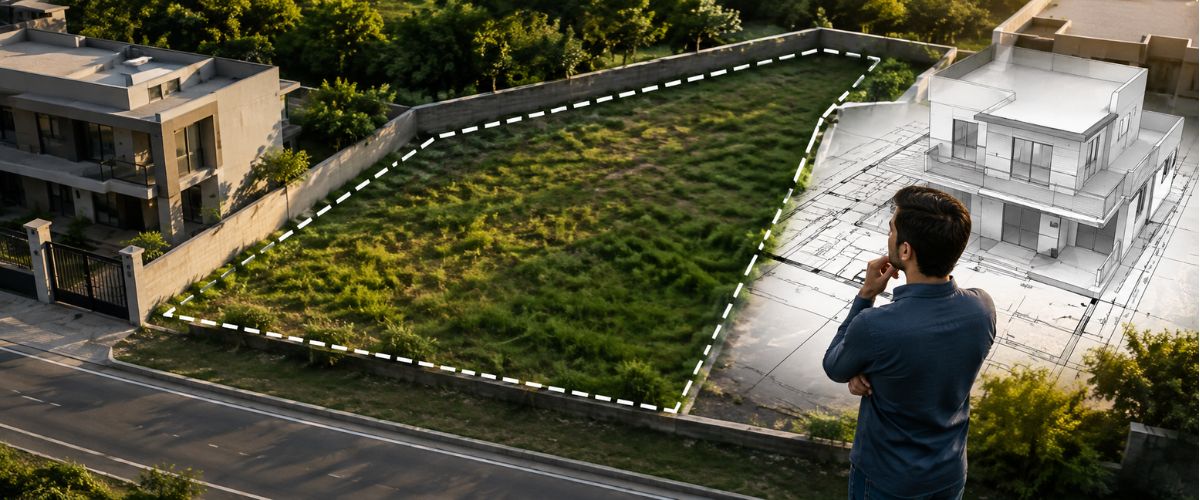
Anyone who has spent time browsing plot listings — whether in a metro suburb or while looking at plots near Khatu Shyam — has come across one at a noticeably lower price than similar-sized plots nearby, and the reason is usually the shape. Irregular plots (slanted, triangular, L-shaped, or with uneven corners) come up again and again in buyer discussions, and opinions are sharply divided between "never buy one" and "it depends on the deal." This guide covers every angle — practical, financial, legal, and Vastu — and directly answers the questions buyers most commonly ask.
A regular plot is a square or rectangle with all four corners at 90 degrees and straight boundary lines. A plot is considered irregular when it deviates from this in any way, including:
1. Harder to Resell
This is the most consistently cited reason. Most buyers actively search for regular shaped plots, so an irregular one narrows your future buyer pool considerably. In practice, sellers often end up pricing the plot by its smaller "effective rectangular area" rather than the full stated area, or offering a discount — commonly cited around 10% — just to attract a buyer. If you are buying primarily as an investment rather than for personal use, this directly affects your exit.
2. Reduced Buildable / Usable Area
Local building bye-laws require a mandatory setback — open space between the boundary wall and the actual construction — on all sides. On a regular plot, this setback is uniform and predictable. On an irregular plot, the setback rules still apply on every side, which means narrow or sharply angled portions of the land can become effectively unusable for construction. The plot's stated area on paper is often larger than what you can actually build on.
3. Difficult and Costlier House Design
Architects have far less flexibility with non-standard shapes. Rooms may end up with awkward angles, wall space gets wasted in narrow corners, and achieving a functional, symmetrical layout takes more design effort — often at a higher architectural cost. A slight slant is usually manageable with good planning; a heavily skewed or multi-angled shape is much harder to design around economically.
4. Boundary Ambiguity and Dispute Risk
With a regular plot, boundaries are simple to describe, verify, and defend. With an irregular plot, the boundary line is less intuitive to explain or visually confirm on-site, which increases the chances of measurement disagreements with neighbors or during resale. A proper survey and demarcation by a licensed surveyor is strongly recommended before purchase.
5. Lower Bank Valuation and Loan Eligibility
Banks and NBFCs sometimes value irregular plots lower than a regular plot of the same stated area, since the effectively usable area is less. This can reduce the loan-to-value ratio you're offered, meaning a higher down payment out of pocket. Some lenders are simply more cautious about irregular land as collateral.
6. FSI/FAR Utilization Loss
Even where the local Floor Space Index (FSI) or Floor Area Ratio (FAR) permits a certain built-up area based on plot size, an irregular shape can make it practically difficult to use the full permitted FSI, since design constraints prevent efficient use of every square foot.
A large share of the resistance to irregular plots in India comes from Vastu Shastra, which treats plot shape as connected to how energy flows through a home. Some key points from Vastu tradition:
Vastu remedies for an irregular plot , where the buyer wants to proceed anyway, commonly include:
Opinions on Vastu are genuinely split among buyers — some report positive personal experience following it, others consider it an inherited belief with no evidence behind it. Since it directly affects resale (a meaningful share of buyers do screen for it), it's worth factoring in even if you personally don't follow it.
Irregular plots are not automatically a bad decision. They can make sense when:
Q1. Is it bad to buy an irregular shaped plot?
Not inherently — but it does come with real trade-offs: lower resale demand, reduced usable area after setbacks, higher architectural planning effort, and sometimes lower bank valuation. Whether it's "bad" depends on how much discount you are getting and what you plan to do with the plot.
Q2. Why do irregular plots sell for less?
Because fewer buyers want them (smaller resale pool), the effective buildable area is often less than the stated area, and construction planning is more complex. Sellers typically have to price by the "rectangular equivalent" area or offer a discount to attract buyers.
Q3. Does an irregular plot reduce the buildable area?
Yes, in most cases. Setback requirements apply uniformly to every side of the plot, and on an irregular shape this can make narrow or angled sections effectively unusable, even though they still count toward the plot's total area on paper..
Q4. How much discount should I expect on an irregular plot?
There's no fixed rule, but buyer discussions commonly reference figures around 10% off comparable regular plots, sometimes more depending on how severe the irregularity is and local demand. It's best negotiated case-by-case after getting the actual buildable area assessed.
Q5. Is an irregular plot the same as a corner plot?
No, these are different things. A corner plot is a regular or irregular plot located at a road junction, valued for its dual road frontage and visibility — often at a premium. An irregular plot refers specifically to a non-standard shape and can occur anywhere, not just at corners.
Q6. How do I know if an irregular plot's discount is genuinely a good deal or just compensating for a bigger problem?
Compare it against at least two to three regular plots of similar size in the same immediate micro-location, then subtract your architect's estimate of lost buildable area and any construction cost premium from the price difference. If the adjusted price is still meaningfully lower, it's a stronger case for a genuine deal rather than a masked problem.