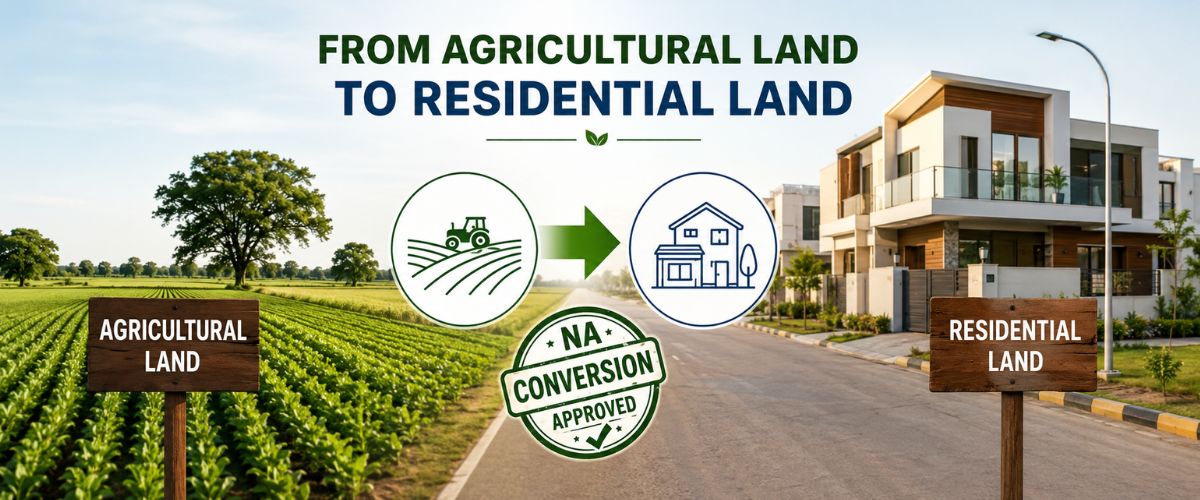
In India, most plot parcels are originally recorded as agricultural, even in areas that have grown into residential neighbourhoods over time. Before any construction can legally begin, this agricultural status must be changed through a formal process known as agricultural land to residential conversion, commonly referred to as NA (Non-Agricultural) conversion.
conversion is the legal process of changing a plot's classification from agricultural to non-agricultural use, allowing it to be used for residential, commercial, or industrial purposes. Since all land in India is treated as agricultural by default under state revenue records, this reclassification is mandatory before any residential structure can be built on it. Without completing agricultural land to residential conversion, construction is technically illegal, regardless of how developed the surrounding area may appear.
Before applying for NA conversion, it is important to understand that not everyone is legally eligible to purchase agricultural land in India. Land ownership rules for agricultural plots vary significantly from state to state, and in several states only individuals classified as "agriculturists" are permitted to buy such land.
States like Maharashtra, Gujarat, and Karnataka have historically restricted agricultural land purchases to those with a farming background or existing agricultural landholding, while states like Tamil Nadu impose no such restriction on buyers. Karnataka relaxed its rules in 2020, allowing non-farmers to purchase agricultural land as well, subject to certain income conditions.
NRIs face additional restrictions and are generally not permitted to purchase agricultural land, though they can inherit it. Before pursuing an agricultural land to residential conversion, buyers should confirm their eligibility to purchase the land itself under their state's land revenue laws.
The conversion process begins with filing an application with the relevant land revenue authority, typically the Deputy Commissioner's office or the Tahsildar, depending on the type of land rights involved. The application must be accompanied by ownership documents, land records, and a survey sketch of the plot.
Key supporting documents usually include the title deed, a 30-year Encumbrance Certificate, the RTC or 7/12 extract (Record of Rights, Tenancy and Crops), and updated mutation records confirming current ownership. Once submitted, the land undergoes inspection and verification at multiple stages before an approval order is issued. In states with digital land records, this process is increasingly integrated with online revenue portals, making tracking easier for applicants.
Buyers often confuse NA conversion with layout approvals such as DTCP or HMDA, but the two serve different purposes. NA conversion changes the legal classification of the land itself, from agricultural to non-agricultural, while layout approval certifies that a subdivided plot within a planned development meets road, drainage, and infrastructure standards set by the local development authority.
A plot can be NA-converted but still require separate layout approval if it is part of a larger subdivided development, so buyers should verify both statuses independently before purchase.
Conversion approval generally takes between three to six months, though this can extend depending on the location and workload of the local authority. Land situated in a city's prime or fast-developing areas often takes longer to process, sometimes stretching close to a year, because of additional scrutiny and higher demand for conversions in those zones.
Buyers planning immediate construction should factor this waiting period into their overall project timeline rather than assuming approval will be quick.
The cost of NA conversion is calculated as a percentage of the land's value and varies significantly from state to state. Some states charge a flat percentage of the guideline or market value, while others apply variable rates depending on the intended use and location of the plot.
Since these charges directly affect the overall cost of the land, it is advisable to confirm the applicable conversion fee with the local revenue office before finalising a purchase decision.
Not all agricultural land is eligible for conversion. Land falling within a designated green zone is reserved strictly for forest or agricultural purposes and cannot be converted under any circumstances. Similarly, land earmarked for commercial development under a city's master plan may not be eligible for residential conversion, even if the owner intends to build a home. Checking the zoning classification of a plot before purchase is essential to avoid buying land that can never legally undergo agricultural land to residential conversion.
A conversion application will be rejected immediately if the land carries any outstanding dues, mortgages, or encumbrances. Authorities require a clear and undisputed title before processing a conversion request, since any pending financial or legal claim on the property complicates the transfer of land-use status. Buyers should insist on an Encumbrance Certificate and confirm that all previous dues have been settled before initiating the NA conversion process.
Constructing a residential structure on agricultural land without completing the conversion process is a legal violation and can attract significant penalties from the local authority. Beyond financial penalties, unauthorised construction on unconverted land can face demolition orders and creates serious complications when the owner later wants to sell, transfer, or mortgage the property. What might seem like a shortcut at the time of construction often becomes a costly legal problem later.
Conclusion
Agricultural land to residential conversion is not a formality that can be skipped or postponed indefinitely. It is a legal requirement that protects a buyer's ownership, enables bank financing, and ensures that a property can be resold without complications in the future. Choosing a plot that has already completed NA conversion, or verifying its conversion status before purchase, remains one of the most important steps in a safe land investment.