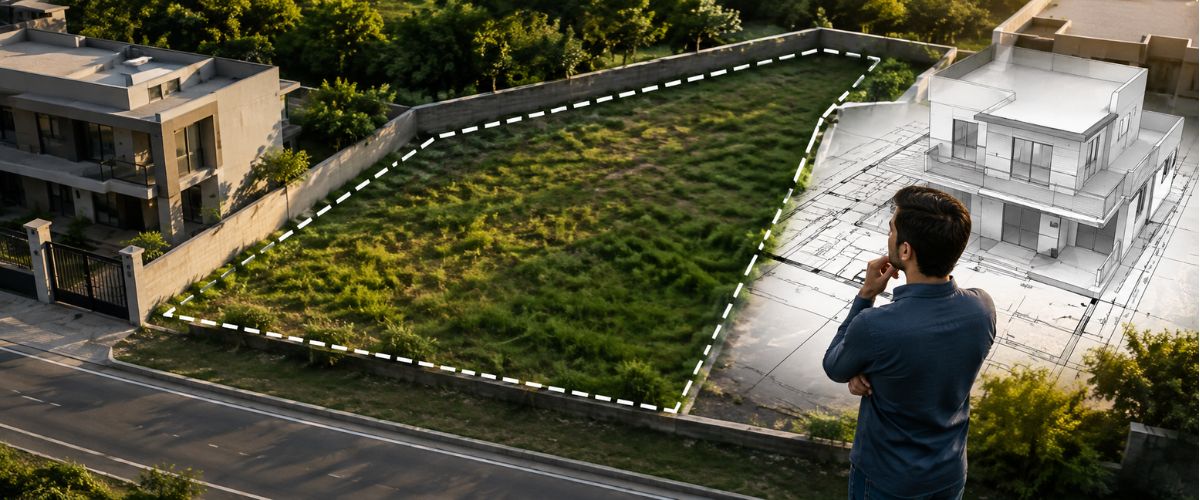

When you purchase a plot or land, paying the seller does not make you the legal owner — you must get the property officially recorded in your name through a government process called plot registry. This is mandatory under Section 17 of the Registration Act, 1908, and any property transaction that is not registered holds no legal validity in a court of law.
Without completing the registry, you cannot prove ownership in a dispute, get a bank loan against the property, or easily resell it in the future. Once registration is complete, your name appears in the Sub-Registrar Office's official government records, giving you and your investment full legal protection. For example, projects like Khatu Green Heaven near Khatu Shyam come with CLU 90A Approval and clear title deeds, which makes the entire registry process straightforward for buyers.
When registering a plot, buyers are required to pay not one but three separate government charges. The first is Stamp Duty — a state government tax calculated on the property's market value or circle rate, whichever is higher.
The second is the Registration Fee — an administrative charge paid to the Sub-Registrar Office for officially recording the transaction, typically fixed at 1% of property value.
The third is Labour Cess — collected for the welfare of construction workers and charged as a percentage of stamp duty in several states. Stamp duty is a tax that legalises the transaction, while the registration fee is a government service charge — both serve different purposes.
Registry charges vary significantly from state to state. Below are the accurate, up-to-date rates for key states:
Rajasthan (Jaipur): Stamp duty is 6% for male buyers and 5% for female buyers. Registration fee is a flat 1% for all. Labour cess is 20% of the stamp duty amount. The total effective cost for a male buyer comes to approximately 7.2% of the property value. Payment can be made online through the official e-Panjiyan portal.
Uttar Pradesh: Stamp duty is 7% for male buyers, 6% for female buyers, and 6.5% for joint male-female ownership. Registration fee is 1% across all categories. A significant relief exists for family transfers — blood relatives can transfer property at a flat stamp duty of just ₹5,000, irrespective of the property value.
Madhya Pradesh: Stamp duty stands at 7.5% for both male and female buyers — no gender-based concession is available in MP. Registration charges are 3%, one of the highest registration fees among major states in India. Combined, the total transaction cost can reach approximately 10.5% of the property value. Online payment is processed through the SAMPADA portal on the MP IGR website.
Haryana: Stamp duty is 6% for male buyers and 4% for female buyers — a substantial 2% gender difference. Registration charges are fixed on a slab basis: ₹15,000 for properties above ₹50 lakh, ₹10,000 for properties between ₹25–50 lakh, and ₹5,000 for properties below ₹25 lakh. Online payment is available through the e-GRAS Haryana portal.
Punjab: Punjab offers some of the most buyer-friendly rates in North India — stamp duty is 6% for male buyers and just 3% for female buyers. Registration fee is 1%. The 3% gender difference means a female buyer on a ₹1 crore plot saves up to₹3 lakh in stamp duty alone, making Punjab one of the most attractive states for women property investors.
Bangalore (Karnataka): Karnataka follows a slab-based stamp duty structure — 2% for properties up to ?20 lakh, 3% for properties between ₹20–45 lakh, and 5% for properties above ?45 lakh. Effective August 31, 2025, the Karnataka government doubled registration fees from 1% to 2%. The total cost of registration for properties above₹45 lakh now stands at approximately 7.6% of the property value. Guidance values can be checked on the Kaveri 2.0 portal.
The state government fixes a minimum property value for each locality, known as the DLC Rate or Circle Rate. Stamp duty is always calculated on whichever is higher — the declared sale price or the applicable circle rate. This means if you purchased a plot for ₹40 lakh but the circle rate for that area is ?50 lakh, your stamp duty will be calculated on ₹50 lakh.
This rule exists to prevent buyers from undervaluing property declarations to reduce their stamp duty liability. Circle rates can be checked on official state portals such as e-Panjiyan in Rajasthan or IGRS in UP. In many cities, circle rates can differ within the same neighbourhood based on road frontage and exact locality — so always verify the rate for your specific property location before finalising the deal.
At the time of plot registration, both the buyer and the seller must be physically present at the Sub-Registrar Office along with two witnesses. The key documents required include the sale deed, Aadhaar card, PAN card, passport-size photographs, property title documents, NOC (wherever applicable), and proof of stamp duty payment.
A PAN card is mandatory for any property transaction valued at ₹10 lakh or above. For properties purchased above ?50 lakh, the buyer is also required to deduct 1% TDS under Section 194-IA and deposit it using Form 26QB — a requirement that many buyers overlook and end up paying penalties for later.